Frontier industries Inaugural engagement · RBTX Technology

Quantum-Safe

Sector Forecast

Bringing the discipline of quantitative finance to a sector that, until now, has only had editorial narratives.

Sector-level analysis · explainable · evidence-backed · not investment advice, no individual stocks
01 / Approach

A leading-indicator chain. Not a single opinion.

① PapersTech heat
3–7 yr lead
② PatentsCommercialization
1–3 yr
③ HiringR&D direction
6–12 mo
④ PolicyState support
concurrent
⑤ Supply chainSector momentum
12–24 mo
⑥ MarketCalibration only
not the target
15+
Data collectors
25,000+
Signal items
10
Explainable factors
6
Leading indicators

On top of the chain sits a ten-factor, fully explainable scoring model — every conclusion traces back to a measured source. Built on RBTX's quantum-safe industry research (three primary reports, a 16-table hard-data workbook) and Psi's multi-source live-data engine (~27,000 items).

02 / The read

One sector, two diverging tracks.
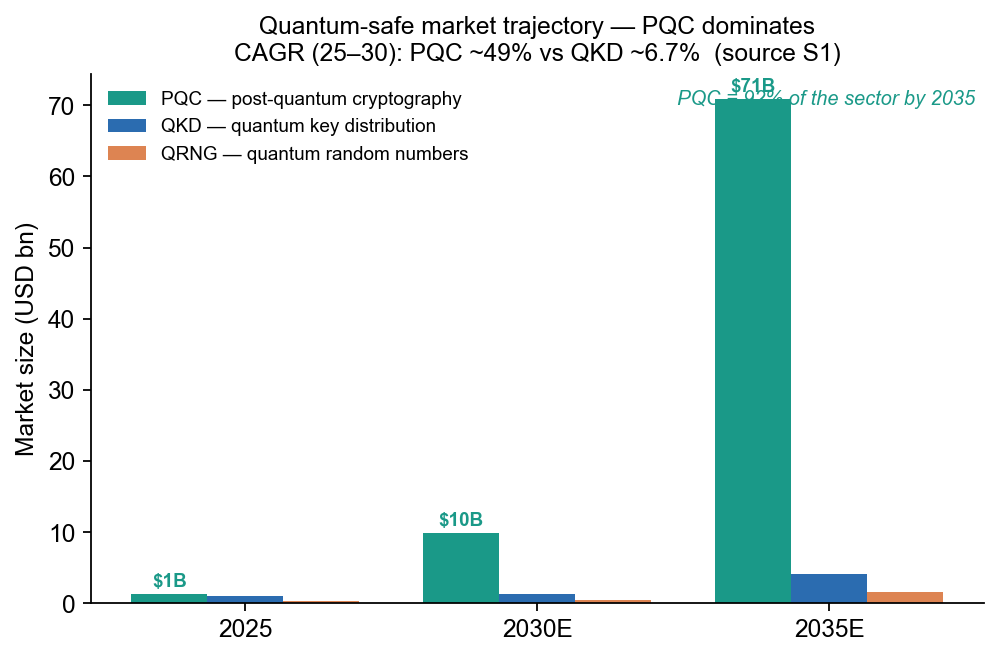
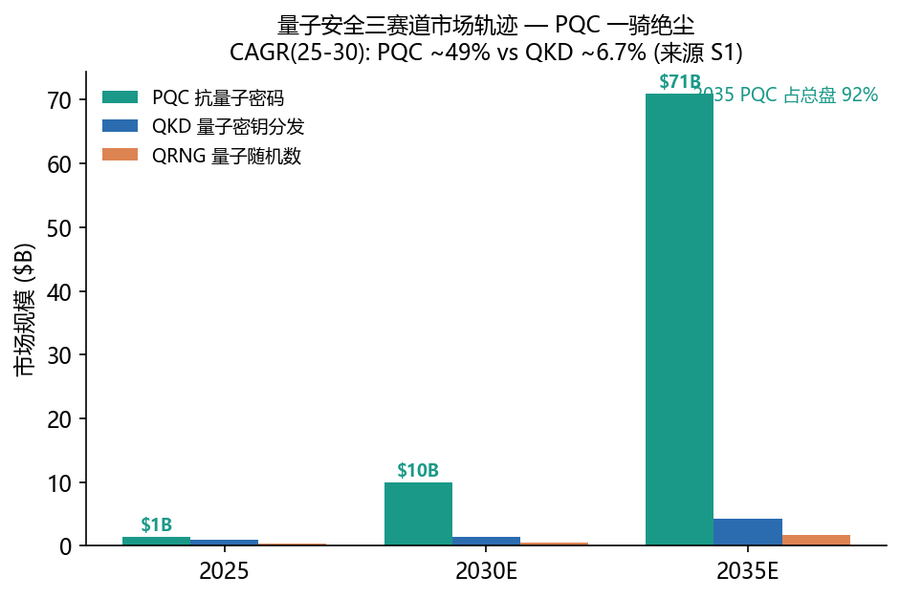
Quantum-safe market trajectory — PQC vs QKD vs QRNG

PQC compounds; QKD crawls.

The global quantum-safe market runs from about USD 2.70 bn (2025) to USD 11.8 bn (2030) and on toward USD 76.8 bn (2035). But the sector is not one thing: post-quantum cryptography (PQC) compounds at ~49% a year and takes ~92% of the pie by 2035, while quantum key distribution (QKD) grows at only ~6.7%.

Any “quantum-safe” read that weights QKD and PQC equally is, in our view, an allocation error. The two are a software track and a hardware track on different clocks.

03 / The mispricing

Capital down. Adoption up.

A divergence, read at the sector level.

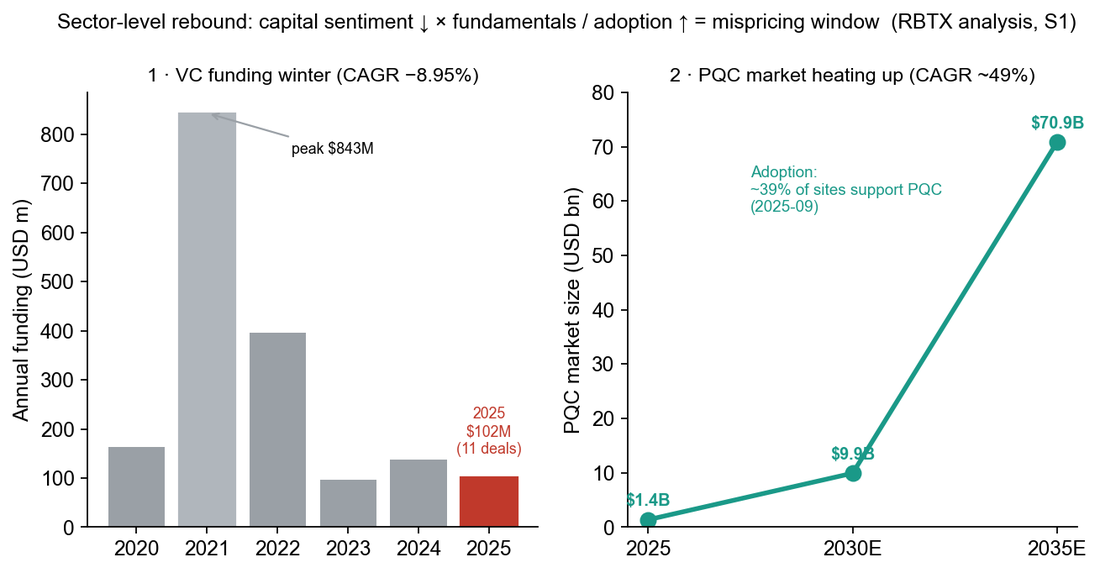
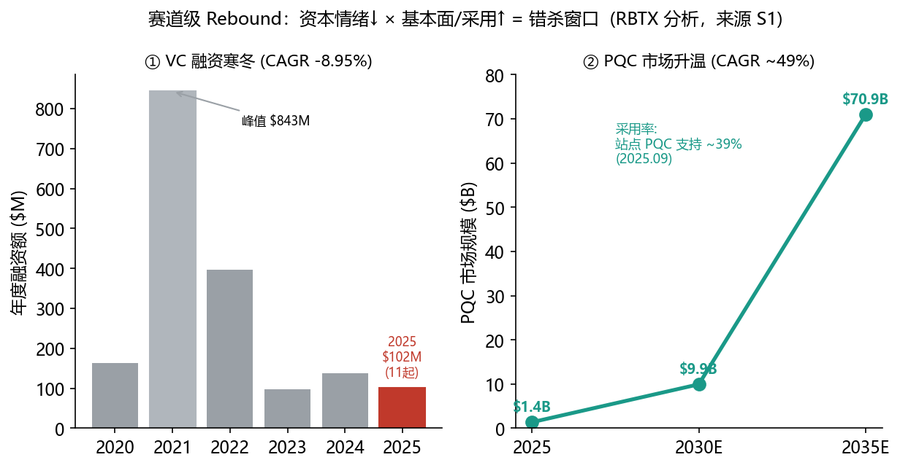
Five years of falling venture funding (CAGR −8.95%) sits directly on top of rising real adoption — about 39% of monitored sites already negotiate PQC, NIST's standards are final, and migration mandates (US OMB M-23-02, EU DORA, NSM-10) are converging.

When fundamentals and capital sentiment diverge this far, the sector tends to re-rate. We read this as a window — and stress-test it with live adoption telemetry rather than treating it as a foregone conclusion.

SignalDirectionEvidence
Capital sentiment↓ winter$843M (2021) → $102M (2025)
Fundamentals / adoption↑ rising~39% sites PQC-ready; FIPS final
Migration mandates↑ convergingOMB M-23-02 · DORA · NSM-10
Sector-level rebound: capital sentiment down, adoption up
04 / Standards & geography

Standardization is the real constraint.

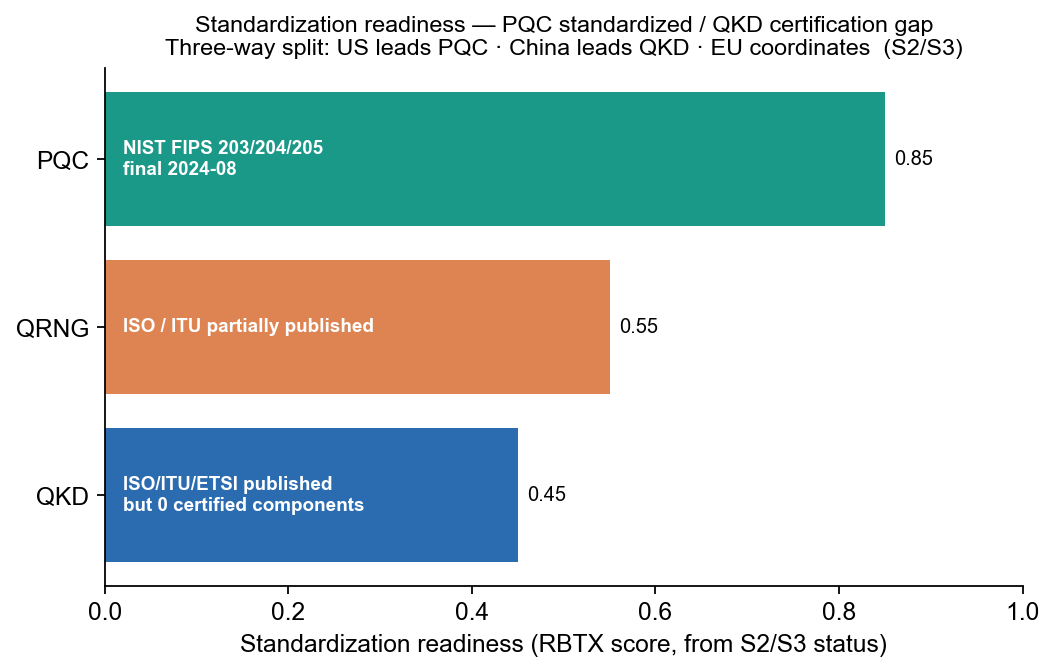
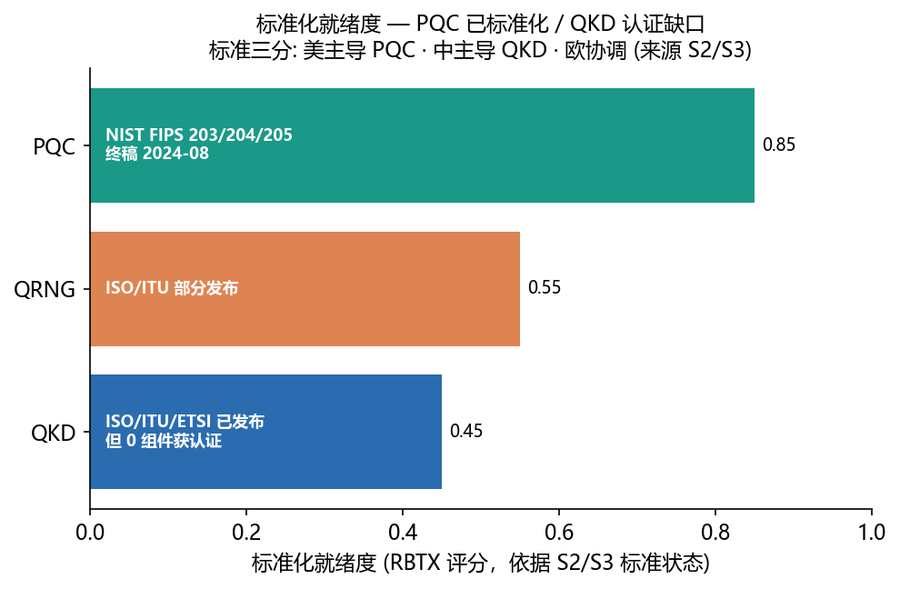
Standardization readiness — PQC standardized, QKD certification gap
Standardization readiness. PQC is standardized (NIST FIPS 203/204/205, final 2024-08); QKD is held back by a hard fact — zero QKD links or components have a Common Criteria certification, and the ISO and ETSI paths are not yet coordinated. That gap is the structural reason QKD stays slow.
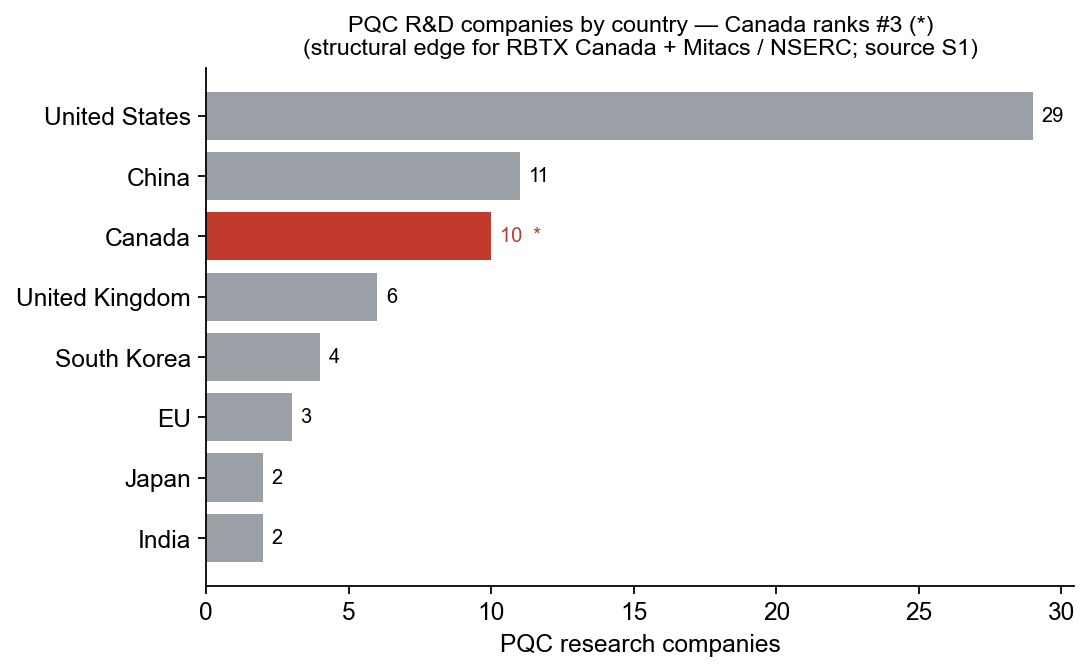
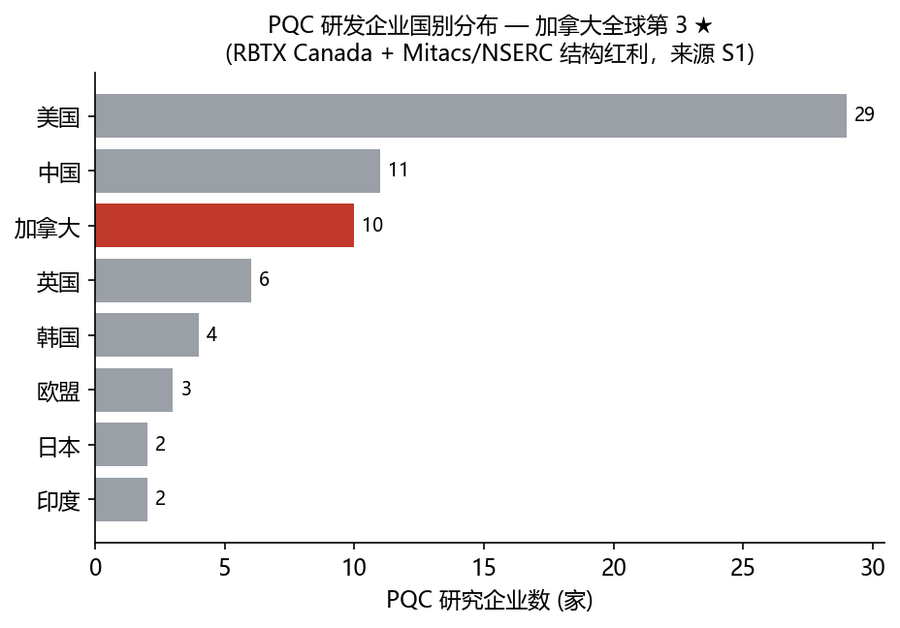
PQC R&D companies by country — Canada ranks third
A three-way split — US leads PQC (NIST), China leads QKD (CCSA: 26 industry + 4 national standards), the EU coordinates (ETSI / CEN-CENELEC). Canada is #3 in PQC R&D firms (10), including the Waterloo cluster — evolutionQ (Mosca), ISARA, Crypto4A, QEYnet, InfoSec Global.
05 / Cross-validation

The reports give direction. Our live data confirms it.

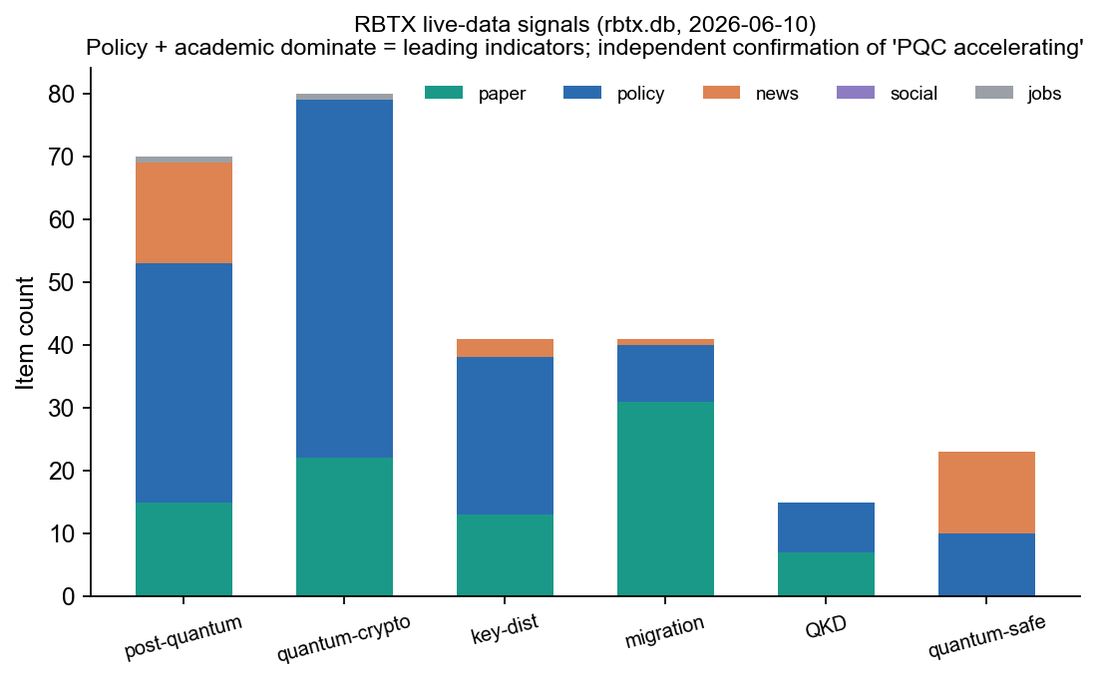
RBTX live-data signals by source type

Independent confirmation, not a single source.

We don't take the industry reports on faith. Querying our own live database directly: 57 post-quantum items, 80 quantum-cryptography items, plus key-distribution and migration signals — dominated by policy and academic sources, exactly the leading-indicator profile the chain predicts.

Spending records surface real DoD PQC contracts (Post Quantum Labs, Secrecy Labs, Mainsail, Nuts Technologies). The reports say “PQC is accelerating”; our independent live data says the same. That cross-check is what turns an annual snapshot into a monitorable signal.

06 / Predictions

Five calls. Each with a confidence and a clock.

#PredictionConfidenceHorizon
P1PQC decisively outgrows QKD; a sector view should sit ~80% toward PQC.High2025–28
P2Value shifts from algorithm IP to the migration / crypto-agility layer.Med-high2025–27
P3Sector-level rebound — funding recovers in 12–24 months; today's low is the entry window.Medium12–24 mo
P4QKD stays a China / government-infrastructure niche; the certification gap suppresses Western commercial use.High2025–30
P5Canada's PQC over-index becomes a structural dividend for RBTX Canada (Mitacs / NSERC, Waterloo cluster).HighStructural

Confidence and horizon are stated, not implied — and revised as the live data moves. These are sector-level research judgments, not security recommendations.

07 / Deliverables

What clients receive. Detail redacted.

Vendor scoring deliverable, redacted
Per-company quantitative scoring — a 33-vendor Quantum-Safe sub-index encoding technology maturity, ecosystem and standards readiness. Names and scores redacted; only the delivery form and method are shown.
Live-data evidence layer
Underneath every score sits the live-data evidence layer — sector-level signal counts by source, refreshed continuously. The forecast is explainable down to the item.
08 / Original research

Built bilingual. 原始研究图表.

The English figures above are rebuilt from our original Chinese research charts. The source set, kept in the working language of the RBTX analysis, is shown here for provenance.

原始市场轨迹图
市场轨迹 — 三赛道规模与 PQC 主导(中文原图)。
原始错杀分析图
赛道级「错杀」— 资本情绪↓ × 采用↑(中文原图)。
原始标准化就绪度图
标准化就绪度 — PQC 已标准化 / QKD 认证缺口(中文原图)。
原始国别分布图
PQC 研发企业国别 — 加拿大全球第 3(中文原图)。
09 / Engage

Frontier-industry forecasting, by invitation.

[email protected]
Disclaimer. This page presents industry research and quantitative analysis for information only. It is not investment advice, a securities recommendation, or an offer to buy or sell, and gives no opinion on any individual security. Market figures reflect third-party industry sources as of their cut-off and are quoted as approximate; model outputs are research conclusions with no guarantee of accuracy or future performance. Source material includes RBTX industry reports and public multi-source data; model and algorithm IP belong to Psi.